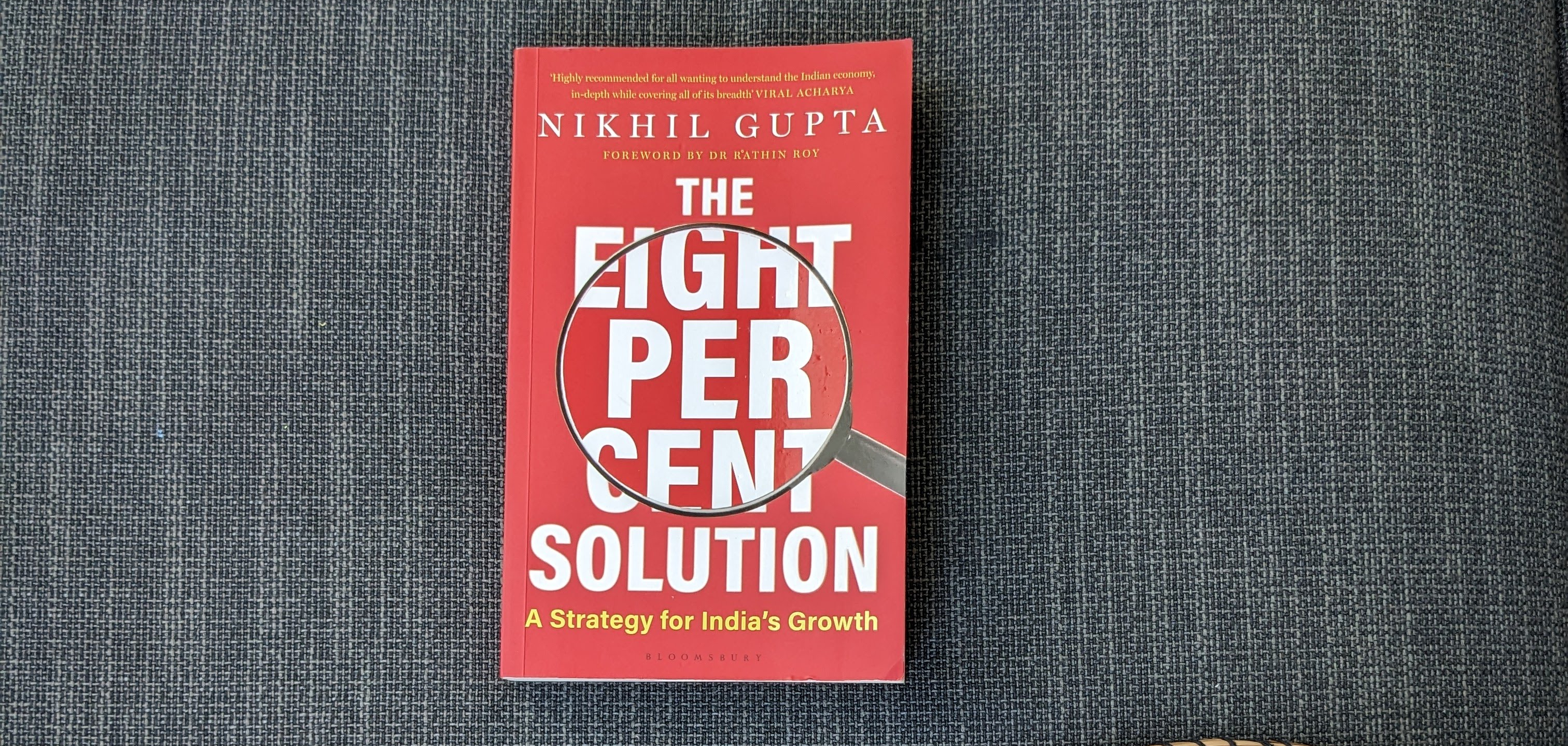

A real world avatar of your undergrad National Income Accounting (NIA) lesson starring the Indian economy. The book argues that maintaining eight percent GDP growth over the long term involves accepting slower growth in the short run. This is a pushback against calls to speed up growth to eight percent urgently and at all costs.
There is something about an argument reasoned through common sense that makes it more convincing than others using technical complexities. The Eight Percent Solution written by Nikhil Gupta falls into this category and was shortlisted as one of the FT’s best books on Economics for autumn 2023. The author is chief economist at Indian brokerage Motilal Oswal and in true economist fashion he frames the issue as one of allocation of scarce resources with a trade off for every economic policy.
He proposes outright that sacrifices in terms of foregone growth during the 2020s are needed to ensure that India can sustainably grow at eight percent or more over the 2030s and beyond. This can make him sound like a fusspot especially at a time when officials from the IMF and the RBI alike have emphasized that eight percent annual growth in real GDP is essential to reduce widespread poverty and inequality in India. Nikhil Gupta’s book provides counterarguments to sober down the ubiquitous calls to boost growth to this magic number immediately and at all costs.
The author analyses the balance sheets of the three economic sectors – household, corporate, and government. Grounding his analysis in economic theory, he works out nearly all of his arguments using the single National Income Accounting (NIA) identity which states that Investment = Savings + Current Account Deficit.
His analysis of the household sector balance sheet reveals a deterioration for the first time in seven decades – with consumption growth exceeding income growth alongside a worrying rise in leverage. For the corporate sector he includes both the listed and the unlisted sectors and assesses that the unlisted corporate sector is highly profitable and resilient which takes aggregate corporate profits to around 8-9% of GDP (versus the mere 2-3% for listed companies). While this heartening to know, he notes the lack of investment despite strong corporate profitability. Together with the rising household leverage, this is a recipe for an economic slowdown.
On the government sector he notes that the adjusted fiscal deficit of the central government touched an eight year peak of 5.7% of GDP in FY20 due to the pandemic and should necessarily remain in consolidation mode to meet the mandated targets. The worrisome trend for this sector is that the general government absorbed the entire household surplus during the 2010s decade which left the corporate sector short changed in terms of access to loanable funds. This should not continue.
The author balances the data heavy analysis of these macro trends by interspersing it with his views on the government’s current policies. He takes issue with fiscal and monetary policies that have incentivized retail lending by banks during the 2010s and emphasises that sustainable economic growth requires that the corporate sector be the primary driver of rising leverage rather than households. He also evaluates the worth of popular economic nostrums such as the Production Linked Incentives (PLI) scheme to boost domestic production or social schemes to redistribute wealth.
The book is written in simple language and systematically organized into eponymous chapters for each economic sector followed by chapters on the interlinkages among the sectors and the influence of financial markets. Throughout each chapter, the author repeatedly stresses the uniqueness of India’s starting point and its stage in economic history which make its problems, and hence possible solutions, incomparable with the past experiences of other emerging economies in Asia or early capitalist economies elsewhere.
The Eight Per Cent Solution is essential for gathering a realistic view of the distinctive challenges faced by India. Being a democracy, financial suppression of households or government directed corporate investments are untenable. Secondly, India’s comparative advantage in services means that relying on low labor cost of manufacturing to drive growth will not take us far. Acknowledging this, the author then highlights the policy options for India and governance lessons from the East Asian tiger economies to boost growth. Read it to find what they are.
Non economists would find the book extremely useful for its description of the typical behavior of each economic agent and the broad stroke trends of each sector. At its core, The Eight Per Cent Solution is essentially an exposition of textbook macroeconomic concepts via real world economic data. To do this for an economy the size of India with all its data idiosyncrasies and to weave a balanced analysis around it is a formidable task and hence very noteworthy.
 Macrologue